

Allied Health Graduates Urged To Embrace Lifelong Learning
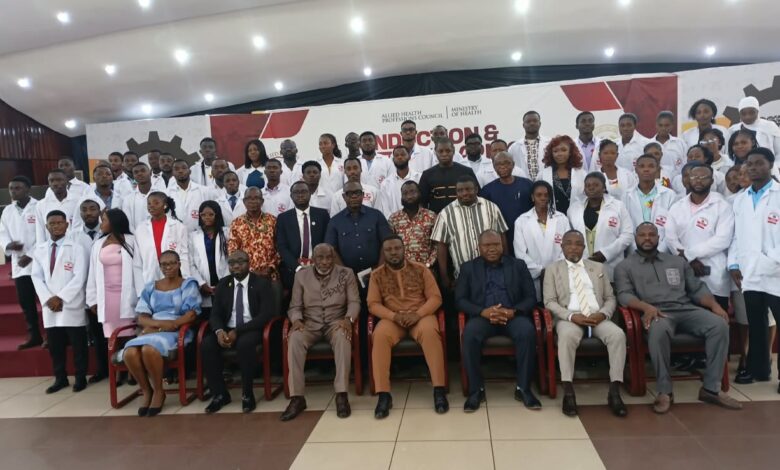
The Associate Professor of Clinical Ultrasound and Echocardiography and Dean of the Faculty of Allied Health Sciences at the Kwame Nkrumah University of Science and Technology (KNUST), Prof. Yaw Amo Wiafe, has urged newly qualified allied health professionals to make lifelong learning a habit to remain competent and deliver quality healthcare.
He said continuous professional development was critical to keeping pace with advances in medical knowledge, diagnostic technologies and treatment methods, warning that knowledge acquired through university education alone could not sustain practitioners throughout their professional careers.
Prof. Amo gave the advice as the guest speaker at the induction and oath-swearing ceremony for newly qualified allied health graduates in Kumasi.
The ceremony was held on the theme, “Setting the Standard: Regulating Service, Safety and Excellence Across Universal Health Coverage.”
He urged the graduates, including medical laboratory scientists, sonographers, radiographers, radiotherapists and other allied health practitioners, to cultivate the habit of regularly updating their knowledge, refining their skills and adapting to emerging scientific evidence.
According to him, the motivation for continuous learning should not merely be to acquire additional academic qualifications, accumulate continuing professional development (CPD) points or renew professional licences, but to improve the quality of care provided to patients.
“The greatest motivation should be to serve your patients better,” he stressed.
He explained that every new skill acquired, scientific paper read and professional training programme attended should ultimately translate into better clinical decisions, improved patient safety and positive health outcomes.
Patients Becoming Informed
Prof. Amo observed that patients were increasingly becoming informed about their health conditions, diagnostic procedures and treatment options through social media, online medical resources and artificial intelligence platforms.
He said healthcare professionals must therefore remain abreast of developments in their fields to respond effectively to patients’ questions and provide accurate explanations about their care.
He noted that although some medical information available online was inaccurate, patients were becoming more empowered to question the quality of healthcare services they received.
He urged the graduates to develop the ability to interpret scientific evidence, exercise sound clinical judgement and explain to patients not only the procedures being performed but also their importance to treatment and recovery.
Prof. Amo further warned that increasing awareness of patients’ rights could expose healthcare practitioners to greater scrutiny, complaints and potential legal challenges when professional standards were not upheld.
He said the best protection against such challenges was professional competence, ethical conduct, sound clinical judgement and a commitment to patient safety.
He consequently advised the graduates to practise within their recognised scope of practice, obtain appropriate consent, communicate effectively with patients and maintain accurate clinical records.
Internship Is Not For Experimentation
The Registrar of the Allied Health Professions Council (AHPC), Prof. Shirazu Issahaku, also urged the newly inducted graduates to take their one-year internship seriously and avoid practising beyond their competence.
He said more than 15,000 professionals across 12 allied health disciplines in the country’s 16 regions were being inducted as part of efforts to strengthen professional standards and improve healthcare delivery.
Prof. Issahaku explained that the internship was intended to equip the graduates with the practical knowledge and skills required before they obtained their full professional licences.
He directed them to comply with the prescribed dress code, carry the necessary professional documents and submit regular reports on their activities through the council’s digital platform.
He disclosed that the council would visit the facilities where the interns had been posted to monitor their activities and ensure compliance with the requirements.
“This is not a time to go and experiment. This is a time for you to study,” he cautioned, urging the graduates to seek guidance from their supervisors whenever they encountered unfamiliar clinical situations.
He also announced the introduction of a welfare assessment component to evaluate the interns’ conduct, interpersonal relationships and respect for supervisors and senior colleagues.
Prof. Issahaku warned that interns who breached professional requirements or exhibited unacceptable behaviour could face sanctions, including withdrawal from their assigned facilities.
He said the graduates would be required to sit a council examination at the end of the training period, with questions focusing on the practical knowledge and experience acquired during the internship.
Call For Patient-Centred Care
The Chairperson of the AHPC, Prof. Eric Desmond Kotei Addison, said universal health coverage must go beyond providing access to hospitals to ensuring that everyone received quality healthcare irrespective of income, geographical location or social circumstances.
He said the council remained committed to regulating professional practice, establishing standards for service delivery and ensuring accountability among healthcare practitioners.
Prof. Addison stressed that patient-centred care must remain the priority, with respect for patients’ rights, effective communication, professional integrity, timely diagnosis and appropriate treatment serving as essential components of healthcare excellence.
He said the performance of the country’s healthcare system should not be measured solely by the number of hospitals constructed, professionals trained or patients treated.
Rather, he said, greater attention must be given to improved patient outcomes, reduced preventable harm and consistent standards of care across healthcare institutions and geographical areas.
He urged the newly qualified professionals to uphold high standards of service delivery and contribute to improving healthcare outcomes in Ghana.