
KNUST Don Warns Against AI Dependence
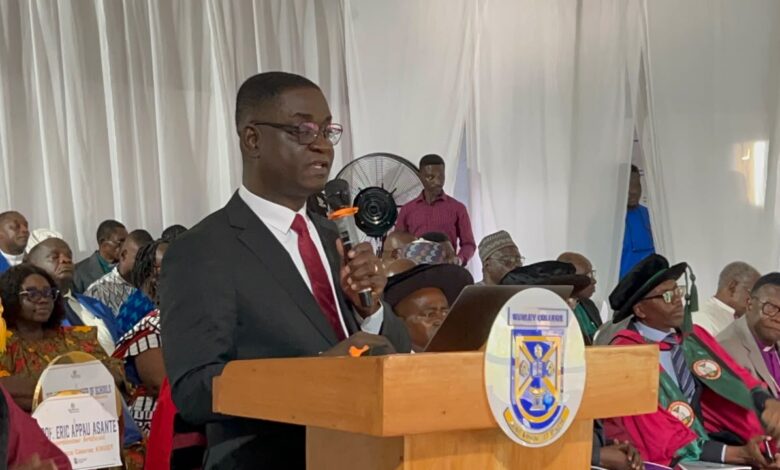
A leading Artificial Intelligence (AI) expert at the Kwame Nkrumah University of Science and Technology (KNUST), Professor Eric Appau Asante, has cautioned newly trained teachers against becoming overly dependent on AI at the expense of their professional judgement, creativity and responsibility towards learners.
He said although AI had the potential to transform teaching and learning, its use must not undermine the human values, critical thinking and professional competence required to nurture students and improve educational outcomes.
Prof. Asante, Coordinator of AI Courses at KNUST, gave the warning when he delivered the keynote address at the 17th Congregation of Wesley College of Education (WESCO) in Kumasi on Tuesday, October 20.
Addressing 461 graduands on the theme, “AI in Teacher Education: Navigating Innovation and Implementation,” he urged them to embrace technological innovation while ensuring that AI remained a tool to support, rather than replace, their professional responsibilities.
He explained that AI could help teachers prepare lesson plans, generate assessment questions and provide alternative explanations of difficult concepts within seconds.
However, he warned that careless use of the technology could produce misleading information, weaken independent thinking and expose learners’ personal information.
“If teaching were merely the delivery of information, then machines would already be formidable competitors. But teaching means understanding children, recognising potential, shaping character and exercising judgement in complex human situations,” he stated.
Prof. Asante stressed that teachers must retain responsibility for the quality of lessons delivered, the fairness of assessments and the individual needs of learners.
He cautioned against a situation where teachers relied entirely on AI-generated content without critically examining its accuracy, relevance and suitability for the classroom.
“Never mistake a polished AI output for sound pedagogy. We must not produce teachers who are excellent at prompting machines but weak at understanding the learners,” he said.
Responsible AI In Education
The KNUST don called on colleges of education, the Ghana Tertiary Education Commission (GTEC), the National Teaching Council, curriculum authorities and policymakers to make AI literacy an essential component of teacher preparation.
He said student teachers must be equipped to identify errors and bias in AI-generated materials, protect learners’ privacy, develop effective assessment methods and determine when the technology should or should not be used.
According to him, the successful integration of AI into Ghana’s educational system required appropriate institutional guidelines, continuous professional development and deliberate efforts to ensure that technology improved learning outcomes.
He cited international approaches to AI governance, including the European Union’s AI Act and UNESCO’s AI Competency Framework for Teachers, as useful references for promoting responsible use of the technology.
However, he cautioned that Ghana must develop approaches suited to its own educational needs rather than simply copying policies from other jurisdictions.
Prof. Asante also warned that AI must not widen the gap between well-resourced urban schools and rural institutions struggling with inadequate infrastructure and limited access to electricity.
“AI cannot repair a classroom roof, provide electricity where none exists or replace a teacher who has not been recruited,” he noted.
He maintained that the success of AI in education should be measured by the improvement it brought to learners’ opportunities rather than the number of technological tools introduced into schools.
He challenged WESCO to build on its tradition of academic and character formation by becoming a model for responsible, classroom-centred AI integration.
461 Students Gradua
 te
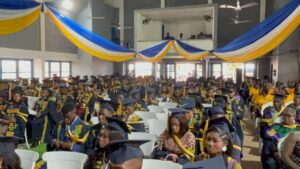
Meanwhile, the Principal of WESCO, Dr. Kennedy Ameyaw Baah, announced that 461 students had successfully completed their programmes and qualified for graduation.
He disclosed that seven students, representing approximately 1.52 per cent, obtained First Class honours, while 329 students, representing 71.37 per cent, earned Second Class Upper honours.
The remaining 125 students, representing 27.12 per cent, obtained Second Class Lower honours. No student graduated below Second Class Lower.
Dr. Baah noted that the graduands constituted the first batch to complete their programmes under the new national uniform grading system introduced in colleges of education four years ago.
Under the new system, students require a Cumulative Weighted Average (CWA) of 80 or a Grade Point Average (GPA) of 4.0 to obtain First Class honours, compared with the previous threshold of 70.
Staff Development
The Principal said management was working towards making WESCO a centre of excellence in pre-tertiary teacher education in Ghana and beyond.
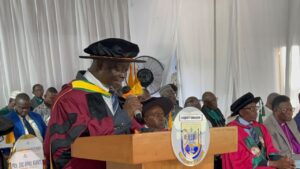
He disclosed that 17 of the college’s 62 faculty members held PhDs, representing approximately 27.45 per cent of the teaching staff.
One additional faculty member had successfully defended a doctoral thesis and was awaiting graduation, while 20 others were pursuing doctoral programmes in their respective fields.
He added that 15 faculty members had attended local and international conferences as part of efforts to strengthen their professional development.
Dr. Baah further announced that the college’s Science Education Department had secured a Commonwealth of Learning grant in Canada for the third consecutive year under its Teacher-in-the-Loop project.
Infrastructure Development
On infrastructure, Dr. Baah disclosed that construction of a 2,000-capacity auditorium, supported by the Methodist Church Ghana, Rango Constructions and the Ghana Education Trust Fund (GETFund), had reached 30 per cent completion at the substructure stage.
The joint college and Students’ Representative Council water project was 50 per cent complete, while renovation works on the second phase of the S.H. Amissah Administration Block had reached 60 per cent completion.
He appealed to the government, GTEC, GETFund and other stakeholders to help complete a 300-bed student hostel that had been abandoned for two years.
He also called for support to complete the four-storey WESCOPA Lecture Complex, whose first-floor construction was 50 per cent complete.
The Principal identified the lack of a modern lecture complex, inadequate staff bungalows and the need for a new 50-seater bus for the college’s weekly Supported Teaching in Schools exercise as major challenges.
He expressed appreciation to the government, the Methodist Church Ghana, the College Council, the Wesley College Past Students Association (WESCOPA), sponsors and staff for their continued support.
Dr. Baah urged the graduands to uphold integrity, compassion and hard work as they entered the teaching profession, reminding them that their responsibility extended beyond imparting academic knowledge to shaping the character and future of their pupils.