

TechnoServe Launches Grant Support Microentrepreneurs and Agri-SMEs
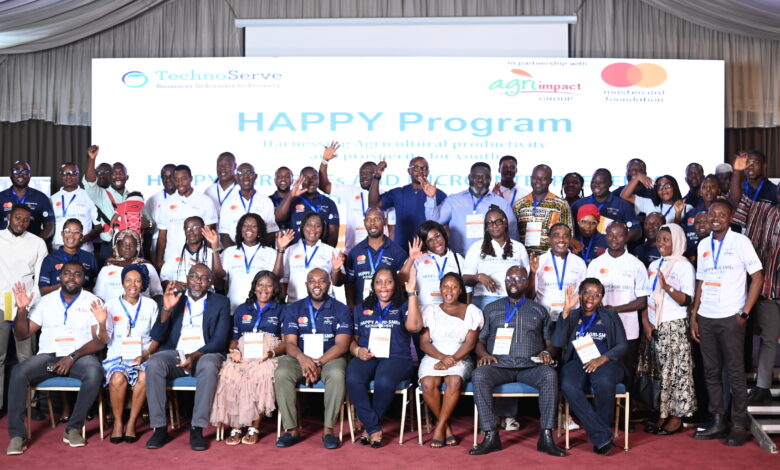
TechnoServe, a leader in business solutions to poverty, has launched the implementation of grant support for agri-SMEs and microentrepreneurs along the poultry, tomato, rice, and soybean value chains in Ghana as part of the Harnessing Agricultural Productivity and Prosperity for Youth (HAPPY) Program.
The HAPPY Program is an initiative of the Mastercard Foundation in partnership with Agri-Impact Limited and is being implemented by a consortium of eight partners, including the Ghana National Service Authority (NSA), Newage Agric Solutions Limited, the Ghana Enterprise Agency (GEA), MiDA Ghana CARES “Obaatan Pa” Programme, Catholic Relief Services (CRS), the Ministry of Food and Agriculture, TechnoServe, and Jobberman.
The kickoff event, held in Kumasi, the Ashanti Regional capital, marked a key milestone under the Mastercard Foundation’s Harnessing Agricultural Productivity and Prosperity for Youth (HAPPY) Program, delivered in partnership with Agri-Impact Limited.
The two-day event provided insights into how agribusinesses can contribute to job creation while leveraging the grant opportunities available through the project.
The event brought together key players in Ghana’s agribusiness space, including industry experts, academia, and implementing partners of the HAPPY Program.
The HAPPY Program is a four-year initiative that seeks to create sustainable job opportunities for 326,000 young people between the ages of 15 and 35, with a 70% focus on women and persons with disabilities (PWDs).
Deputy Chief Executive Officer, Agri-Impact, Juliana Asante-Dartey, in her address explained that the event was to ensure the agribusinesses and microbusinesses understood the consortium’s especially, TechnoServe’s role in the Programme as well as support drive to growth and development.
She stated that the successful implementation of the HAPPY Program is geared toward significantly boosting agricultural production and reducing imports.
She explained, “even though we have increasingly gotten better at being self-reliant, we are still bringing in a lot of rice. Ghana’s demand for poultry is over 400,000 metric tonnes. The country is doing less than 20% of that, so most of it has to be imported. Even tomatoes—we still bring them in from neighbouring countries. The situation is not any different with soya, even though it is needed in the poultry and food processing industries.
“We still are not self-sufficient and, from time to time, need to import to supplement. That is why the HAPPY Program, which is being supported by the Mastercard Foundation, is seeking to improve productivity and production in all four value chains.
“So that at the end of the four years, not only would we have enabled dignified and fulfilling jobs for young people—70 % of whom are young women—but we would also have opened up output and other business opportunities along these four value chains.”
“We are seeking to improve outputs from the value chains to the tune of over 189,000 metric tonnes over the four years. And in terms of import substitution, we hope that we will be able to reduce importation by $200 million by the end of the four years of the programme.”
In his welcome address, HAPPY Program Director, TechnoServe, Frank Obiora Mgbemena, noted that, TechnoServe, over the next two years, will work alongside the participants’ businesses to support business re-engineering efforts by providing technical assistance, grants, market linkages, crop business services, and developing the financial resilience of their businesses to attract more investment.”
For his part, Agriculture Lead for the Mastercard Foundation in Ghana, Daniel Ninson, pointed out that the Foundation was poised to work with business leaders to strengthen ecosystems where young people could thrive.
“TechnoServe recognize that the vehicle to drive economic growth in Ghana lies in supporting small and medium enterprises, led by bold entrepreneurs, energised by the creativity of our youth, and strengthened by the resilience of women,” he stated.
“Mastercard Foundation’s vision is rooted in the belief that young people are the key to Africa’s prosperity. Through programs like HAPPY, we are investing in young entrepreneurs, women-owned businesses, and growth-oriented enterprises that are building the backbone of our economies, especially in the vital agricultural sector,” he stressed.
“Our goal for convening here over the next two-days in support of the HAPPY Program is clear; to support Agri-SMEs and Micro Businesses across key regions in Ghana, to create and sustain dignified jobs for youth, with 70% of these opportunities specifically targeted toward young women and to work together with business leaders like yourselves to strengthen ecosystems where young people can thrive,” he continued.
One of the microentrepreneurs and a team lead at Hakama, a tomato processing company, One of the participants from Hakams Company, Zainab Acheampong, expressing her excitement about the project, disclosed that the technical support and grant will help expand their business.
“When it started, the company was introduced to technical support, which we felt was in the right direction. Now we are looking at grant funding, meaning that we are looking at growth, we are looking into tomorrow, we are looking at what will benefit us as a people today and in the future. So it’s a very good thing for us as a business,” Zainab Acheampong added.