
HAPPY Programme Pushes Poultry Master Plan to Cut Imports
Ghana currently consumes between 300,000 and 460,000 metric tonnes of poultry meat each year, but about 80 to 95 percent of the products on the market are imported, mainly frozen chicken, highlighting the urgent need to strengthen the local poultry industry.
To address this challenge, the Harmonising Agricultural Productivity and Profitability (HAPPY) Programme is driving the development of a Poultry Sector Master Plan to boost local production, improve competitiveness and create jobs, particularly for the youth, women and persons with disabilities (PWDs).
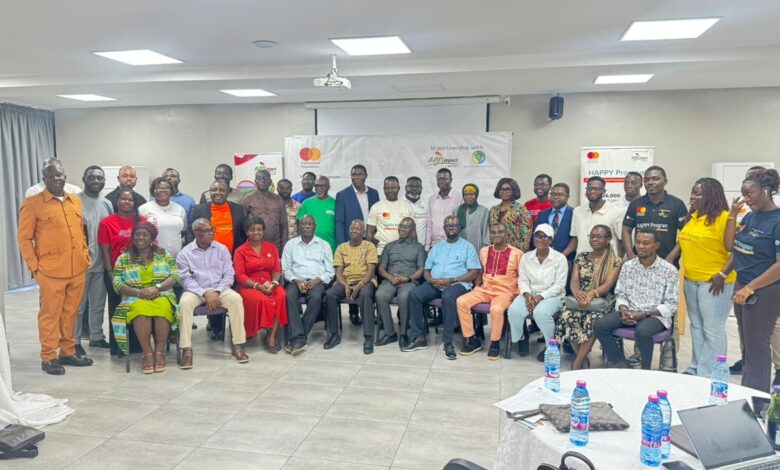
Speaking at a stakeholder engagement in Kumasi, Agribusiness and Value Chain Specialist, Abraham Sarfo, said local poultry producers are beginning to compete more favourably with imported products, supported by easing production costs, improved processing capacity and stronger market linkages.
He explained that although the recent strengthening of the cedi has made imports relatively cheaper, local producers are also benefiting from gradual improvements in the production environment.
“We are competing favourably with imported products. Imports may be cheaper now, but production costs are also improving, even though not yet where we want them to be. As the economy improves, our competitiveness will also improve,” Mr. Sarfo said.
Mr. Sarfo stressed that banning poultry imports is not realistic in a liberal market economy, noting that the focus should rather be on promoting local poultry as a superior option based on quality, freshness and taste.
“No matter how well we compete, imports cannot be banned. The key issue is how to position our local poultry to compete favourably by highlighting its quality and taste,” he said.
The Kumasi engagement formed part of consultations under the HAPPY Programme to develop a Poultry Sector Master Plan, particularly for the broiler industry, which is expected to guide the long-term development of the poultry sector beyond the programme’s lifespan.
The HAPPY Programme is a four-year partnership between the Mastercard Foundation and Agri-Impact Limited, launched in December 2023. It is being implemented by an eight-member consortium including the Ministry of Food and Agriculture (MoFA), National Service Authority (NSA), Millennium Development Authority (MiDA), Ghana Enterprises Agency (GEA), TechnoServe, Catholic Relief Services (CRS), Jobberman and Newage Agric Solutions.
The programme aims to create over 326,000 dignified jobs for young people, with 70 percent targeted at women and inclusion of PWDs. It also seeks to increase food production across the rice, soybean, tomato and poultry value chains by at least 20 percent, while reducing imports of strategic food commodities by 10 percent. As of December 2025, more than 269,000 youth had been onboarded nationwide.
Under the programme, the Poultry Master Plan Stakeholders Dialogue is being led by the Animal Production Directorate of MoFA, in collaboration with Agri-Impact Limited and the Mastercard Foundation. The dialogue is intended to produce a data-driven roadmap to guide investments, reduce import dependence and expand inclusive employment across the poultry value chain.
Mr. Sarfo said the HAPPY Programme adopts a value-chain approach, ensuring that support to farmers is linked to access to feed, processing facilities, markets and an enabling policy environment.
“If you support a young farmer, you must also ensure access to feed, markets and the right policy environment to enable profitability,” he noted.
The poultry sector has attracted new investments in feed formulation, processing and packaging, with some processors now supplying fast-food chains and other high-end markets. During the recent Christmas season, locally produced fresh broilers were supplied to outlets in Accra, Kumasi and other cities, helping to shift consumer preference towards Ghanaian chicken.
Through the HAPPY Programme, Ghana has produced more than 4.3 million birds so far, with total production under supported initiatives reaching about 4.6 million birds. The programme is also helping to promote year-round poultry sales.
“Previously, producers relied mainly on the Christmas season. Now, opportunities are being created for poultry to be sold throughout the year at competitive prices,” Mr. Sarfo added.
Despite the progress, stakeholders say the industry is still operating below capacity. Business Development and Research Manager at Agri-Impact Limited, Prince Manu Yeboah, disclosed that about 60 percent of poultry investment structures across the country are underutilised.
In the Dormaa enclave, which accounts for about 60 percent of Ghana’s poultry activities, facilities with a combined capacity of about 5.2 million birds are operating at roughly 50 percent. In the Ashanti Region, the second-largest poultry hub with a capacity of about 4.2 million birds, utilisation stands at around 60 percent.
Processing remains a challenge, as only about half of broiler production is processed locally, while most layer birds are exported to Côte d’Ivoire.
So far, the HAPPY Programme has leveraged about US$35 million in investments, created nearly 8,000 jobs along the poultry value chain and supported more than 10,000 people engaged in poultry-related trading.
Stakeholders are calling for more targeted investments, stronger institutions and greater inclusion of young people, especially women, in leadership and decision-making within the poultry industry to unlock its full potential.